
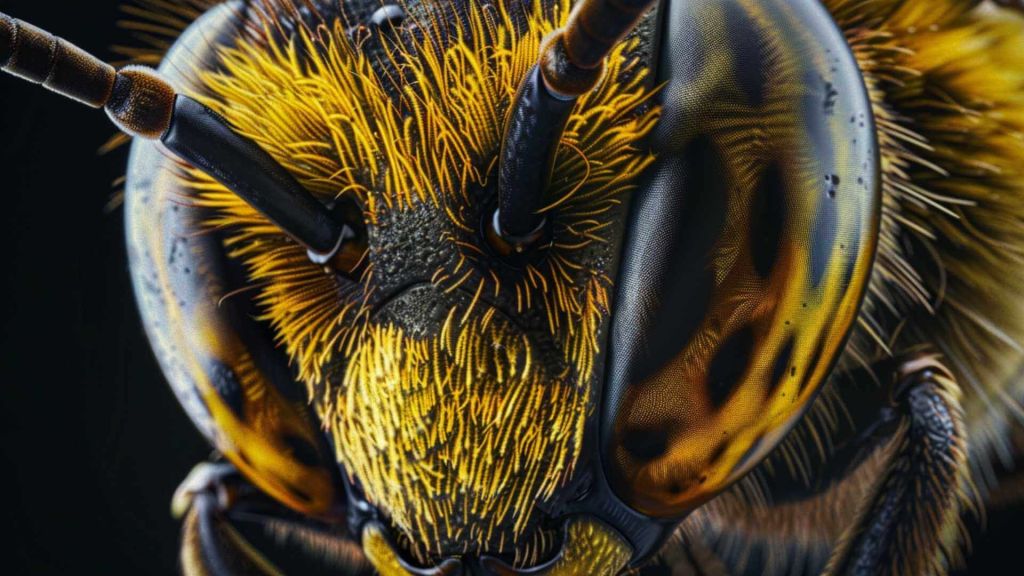
Did you know bees have five eyes: two large compound eyes and three smaller ocelli eyes!
The compound eyes are located on either side of the bee’s head, while the ocelli are in a triangular pattern on top.
The compound eyes are made up of thousands of tiny lenses called ommatidia that work together to create a single image. This gives bees a wide viewing angle of almost 360° and helps them see color, movement, patterns, and UV iridescence. Bees are especially sensitive to the blue end of the light spectrum and ultraviolet light, which makes flowers appear very bright to them. Their color vision is also five times faster than humans, which helps them harvest nectar from flowering plants even when the wind is blowing.
The ocelli, on the other hand, only have one lens and don’t allow bees to see an image. Instead, they help bees detect the direction and intensity of sunlight, follow the sun, and navigate during flight. The ocelli can also help bees sense if they are being approached from above by a predator.
 Ongar Honey
Leave a comment